monkey.poker

Poker mathematics for hand review

MONKEYPOKER · HAND REVIEW

Poker pot odds:
understand the call price.

Check the arithmetic behind a Texas Hold’em call. Enter the pot, the call cost, and your own equity estimate. MonkeyPoker shows the price before you judge the hand.

Calculate pot odds

Pot odds and call value calculator

Use the same unit for both amounts: chips, dollars, or big blinds. Include the opponent’s current bet in the pot. Enter only the extra amount you must pay to call.

Includes the bet you face.
Your additional contribution.
Your estimate; this tool does not evaluate cards.

Method: required equity = call Ă· (pot before call + call) × 100. Expected value = (equity Ă· 100) × final pot − call. Source: MIT OpenCourseWare, Poker Theory and Analytics, “Basic Strategy” (2015). This model excludes rake, side pots, and later bets.

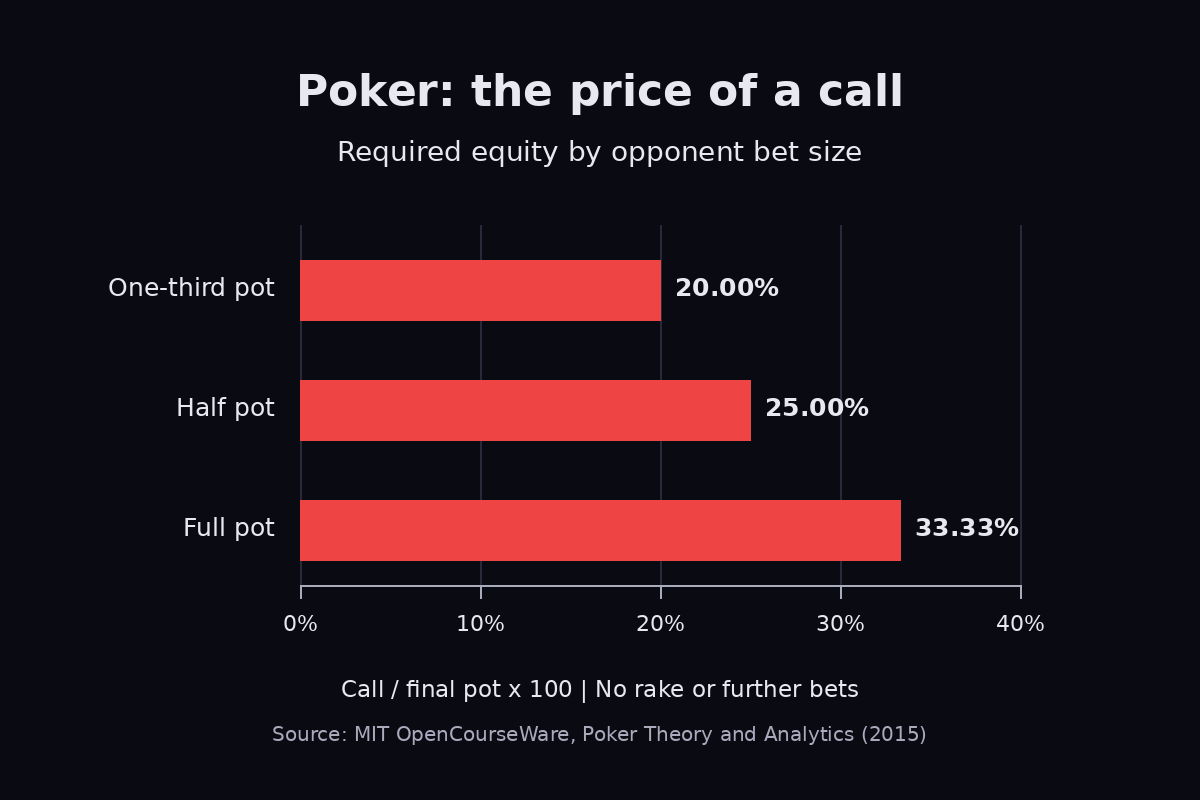
Required equity to call: a one-third-pot bet needs 20.00%, a half-pot bet needs 25.00%, and a full-pot bet needs 33.33%, before rake or later bets.
A larger bet requires more equity. Values use call divided by final pot, rounded to two decimal places. Source: MIT OpenCourseWare (2015).

Read the result without guessing

The price and the hand are separate

Pot odds describe the price of calling. Equity describes your expected share of the pot at showdown, including your share of tied outcomes. A strong-looking hand does not automatically justify every price. This calculator needs your equity estimate; it does not infer an opponent’s cards from the amount they bet.

PokerStars Learn explains this distinction in “Pot Odds Explained” (accessed 2026; no publication year shown). Use the required equity result as a comparison point. Do not treat it as a prediction that your hand will win.

A worked call

Suppose the pot holds 100 chips before your opponent bets 50. Enter 150 for the pot and 50 for the call. Your call creates a final pot of 200. The required equity is 50 Ă· 200 = 25%. The pot offers 150:50, or 3:1, before your call.

At an assumed 30% equity, the expected value is 0.30 × 200 − 50 = +10 chips. At 20%, it is −10 chips. At 25%, it is zero. These are calculated examples under the MIT model, not measured player results.

What expected value means

Expected value is the average change in chips under the stated assumptions. The comparison starts at this decision; earlier contributions already belong to the pot. A positive result does not promise a win in this hand. A negative result means the assumed equity does not cover the call price in this model.

MIT’s 2015 lecture defines expected value through probability-weighted outcomes. Here, a zero result marks the mathematical break-even point. Small differences near that point can disappear when your equity estimate changes.

Review the hand after play

  1. Write down the pot immediately before the call. Check whether your hand history already includes the opponent’s bet.
  2. Enter the additional call cost. Do not enter the opponent’s total raise if you already contributed during that betting round.
  3. Try a lower equity estimate as well as your first estimate. Note how the expected value changes.
  4. Record the reason for your estimate. Separate known cards and actions from guesses about the opponent.

For practice, keep the example pot and call unchanged while moving the equity input. Then restore the starting equity and change the call price. This separates uncertainty about the hand from uncertainty about the price.

When this simple model stops

Use this as a study calculation when no further bets remain, such as a river decision or a fully matched all-in. Future betting can change both your cost and your return. A chance of completing a draw is also not automatically a chance of winning.

PokerStars Learn discusses future winnings in “Calculating implied odds and when it matters” (2025). Implied odds describe possible later winnings; those winnings are uncertain. This calculator leaves them out. It also leaves out rake, the fee taken from a pot, and tournament payout effects.

For side pots, different players can win different amounts. Do not combine those amounts into this single-pot model. Use the result to review your arithmetic, then examine the missing assumptions separately. This page offers study examples, not live-play instructions or guaranteed returns.

Definitions: PokerStars, “Poker Rules” and “Do Play Money games have rake?” (accessed 2026; no publication years shown), explain pot eligibility and rake.